

Strategic Market Intelligence for 2026–2030
Data-driven insights into Europe's largest hospitality market. Understand recruitment pressure, workforce gaps, and strategic opportunities in the German hospitality sector.
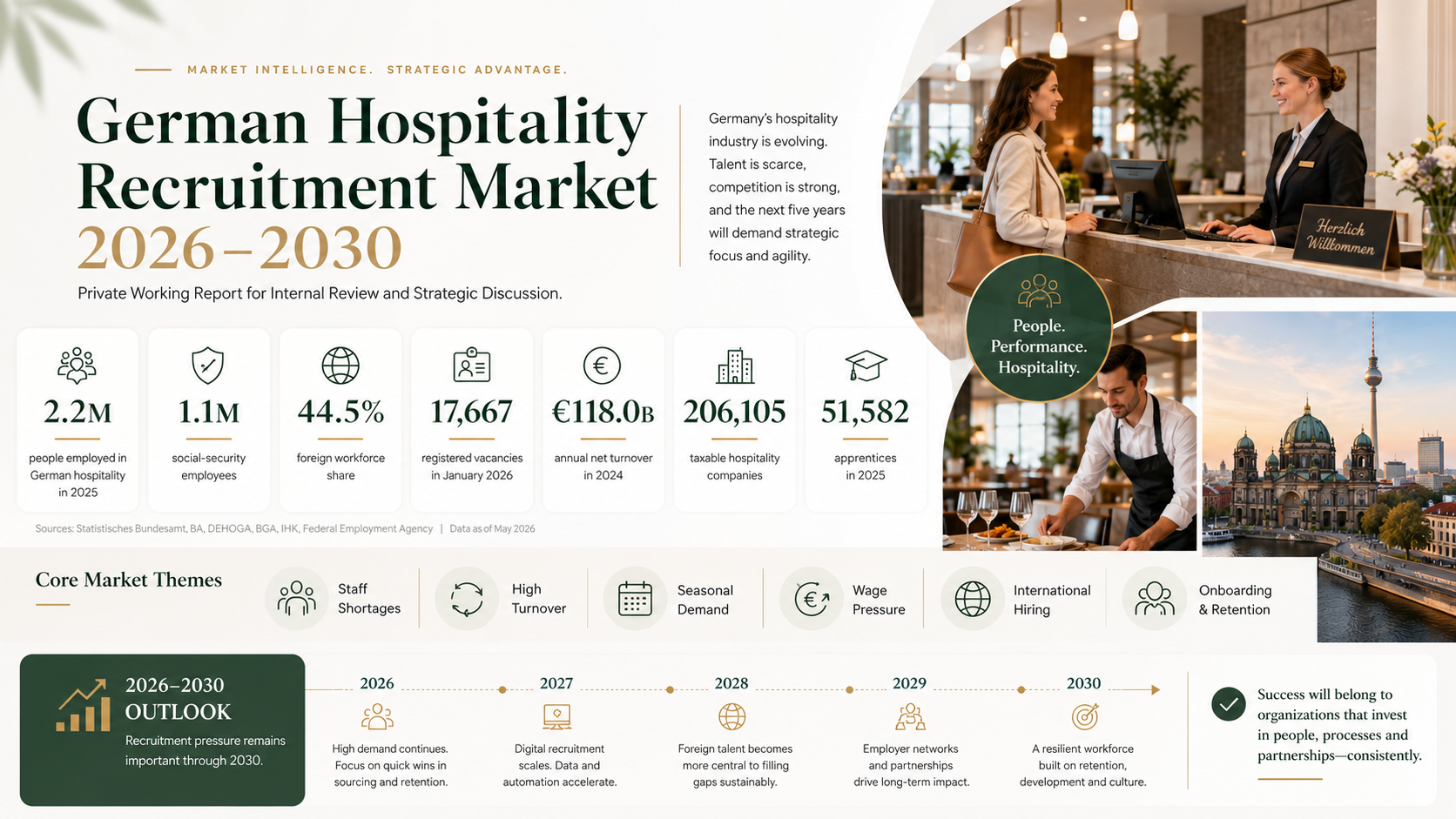
2.2M
People employed in hospitality
€118B
Annual sector turnover
44.5%
Foreign workforce share
17,667
Registered vacancies (Jan 2026)
German Hospitality Market Opportunity & Size
Why This Market Matters
Germany's hospitality sector is one of Europe's largest and most dynamic labour markets. With 2.2 million people employed and €118 billion in annual turnover, the sector represents a substantial economic driver. However, the market faces critical recruitment challenges that create both risks and significant opportunities for the period 2026–2030.
The sector is highly dependent on a large, reliable workforce, yet employers consistently struggle with staff shortages, high turnover, and recruitment friction. This creates a structural gap between labour demand and available supply—a gap that is expected to widen through 2030. See the 2026–2030 outlook for projections, and our Press & Evidence Library for additional research materials.
Market Fundamentals
For detailed employment data and verified baseline figures, see the Key Data section. Additional market research and insights are available in our Press & Evidence Library.
Scale & Structure
- • ~2.2 million total employed
- • 1.1 million social-security employees
- • 206,105 registered hospitality companies
- • 51,582 active apprentices
Economic Importance
- • €118 billion net annual turnover (2024)
- • Major service-sector employer
- • Hotels, restaurants, catering, events
- • Regional economic driver
Strategic Context for 2026–2030
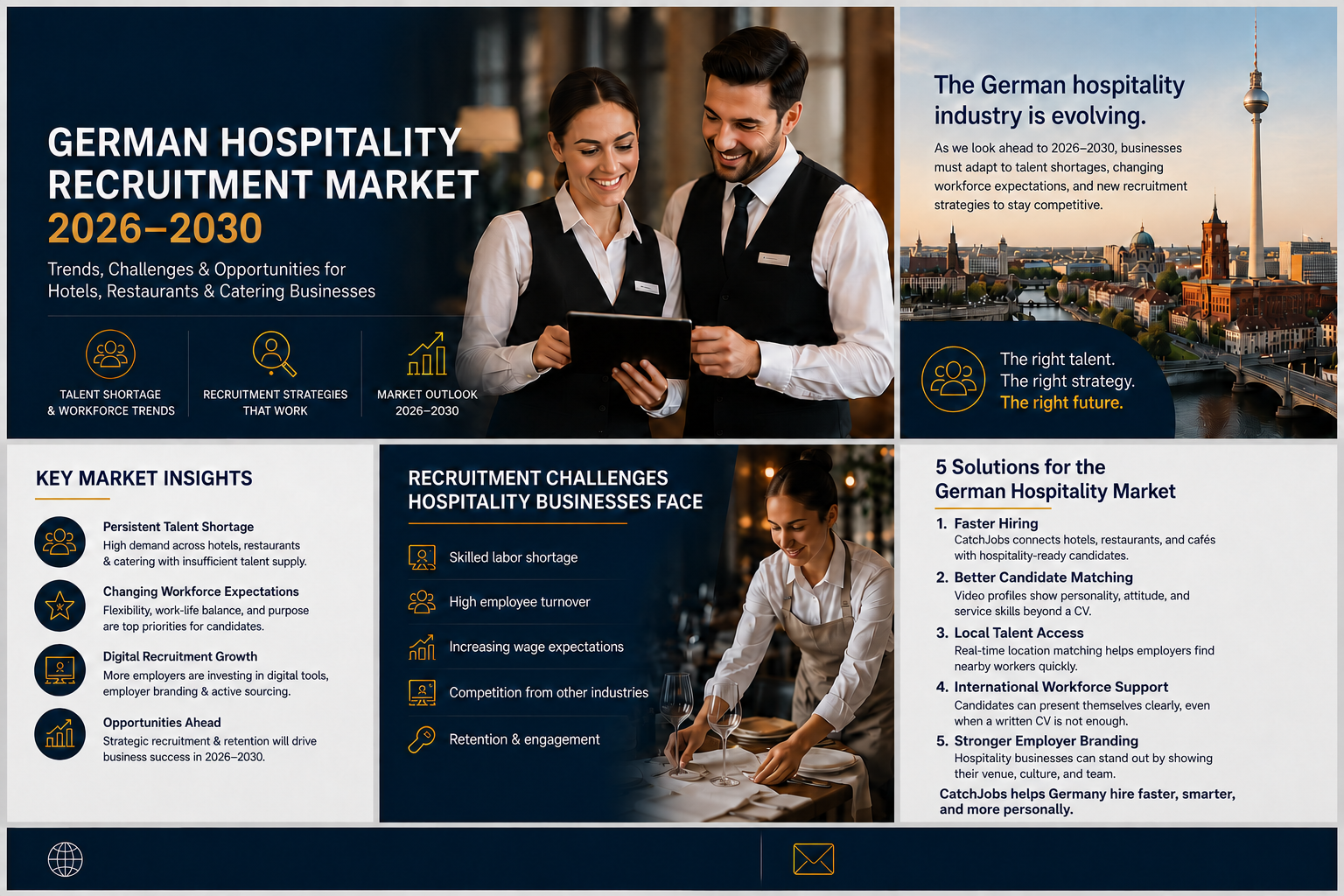
The hospitality sector enters the 2026–2030 period under sustained recruitment pressure. Employers report ongoing staff shortages, high turnover rates, and difficulty filling positions—especially in operational roles. The market is also navigating structural trends:
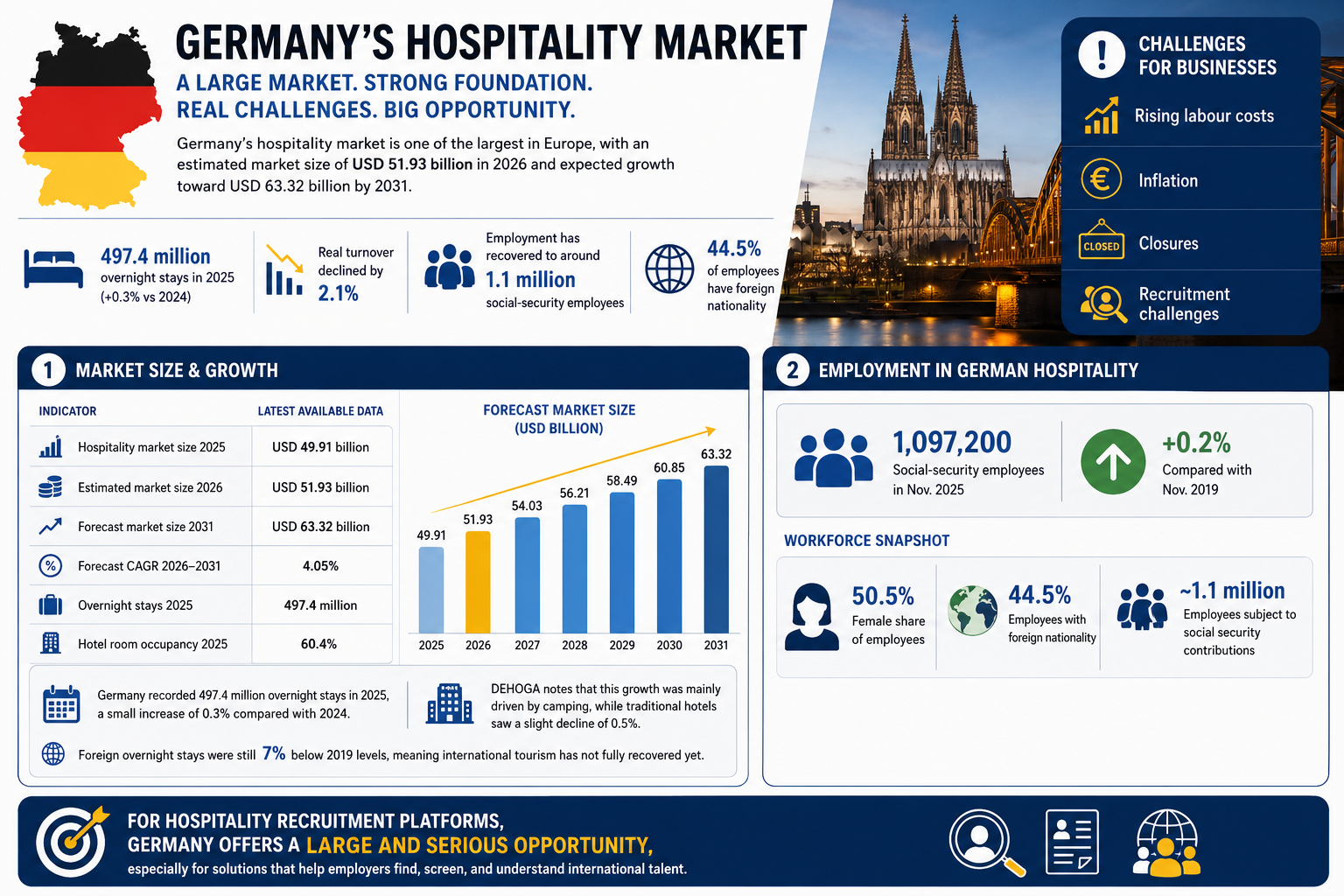
German Hospitality Employment & Market Data
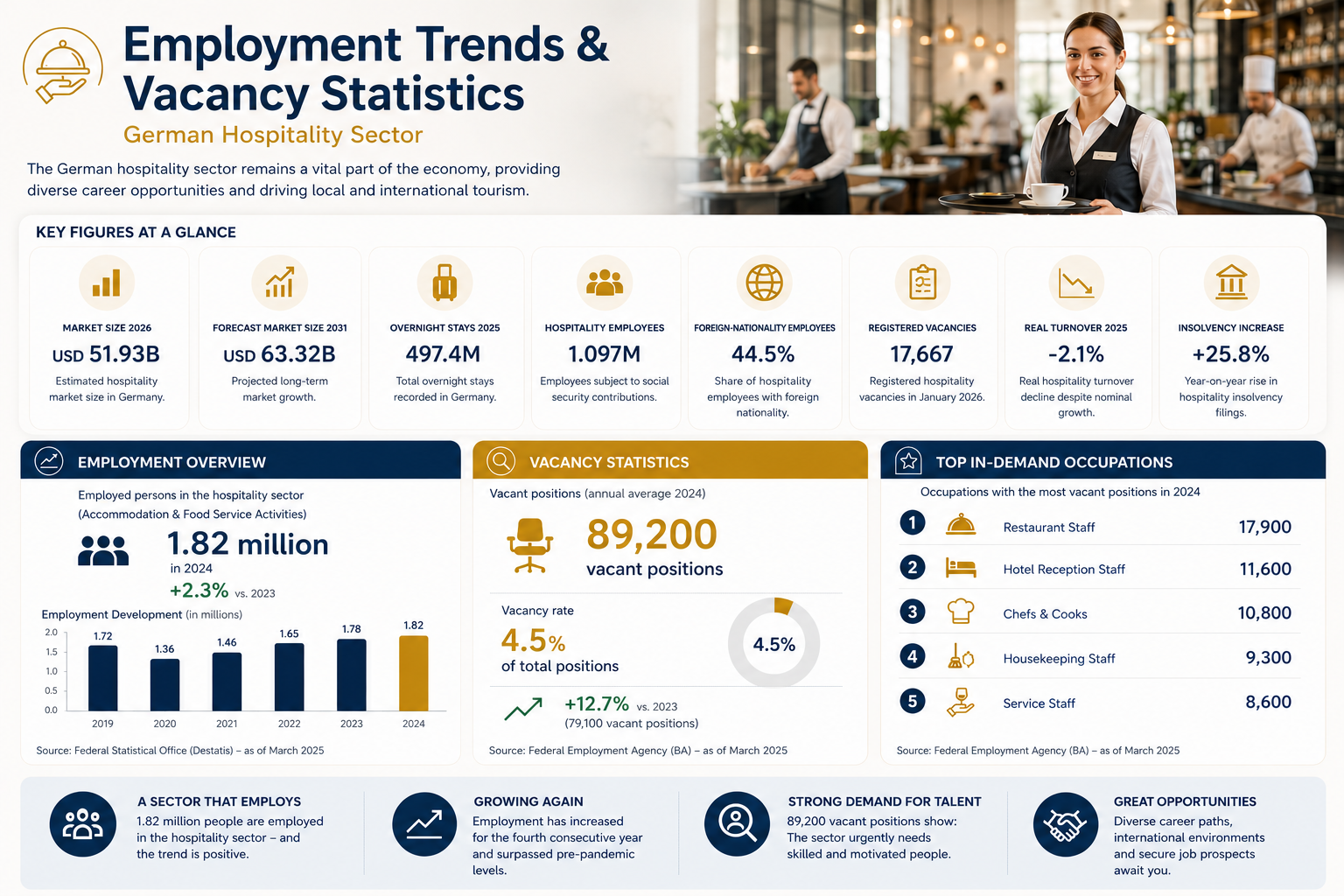
The German hospitality sector at a glance. These verified baseline figures provide the foundation for understanding market size, structure, and recruitment dynamics.
Total Employment
2.2M
People employed in the German hospitality sector in 2025.
Social Security Employment
1.1M
1,119,348 in June 2025; 1,097,200 in November 2025.
Annual Turnover
€118.0B
Net annual turnover in the German hospitality sector (2024).
Foreign Workforce
44.5%
Share of social-security employees with foreign nationality.
Registered Vacancies
17,667
Open positions registered with Federal Employment Agency (January 2026).
Hospitality Companies
206K
Taxable hospitality companies recorded in 2024.
Apprentices
51,582
Active apprentices in hospitality training occupations (2025).
Need More Market Research?
Access detailed analysis and market insights in our Press & Evidence Library.
Download Press & Evidence LibraryData Note: These figures represent the most recent verified baseline data available. For context on how this data reflects current market conditions, see recruitment pressure analysis. Registered vacancies reflect only positions reported to the Federal Employment Agency and do not represent the full recruitment need in the sector.
German Hospitality Recruitment Pressure & Challenges
The German hospitality sector faces sustained recruitment pressure driven by multiple structural factors. Understanding these pressure points is essential for identifying market opportunities. See the 2026–2030 Outlook for projected market trends.
Core Pressure Points
Staff Shortages & Turnover
- • Chronic staff shortages in operational roles (housekeeping, kitchen, service)
- • High employee turnover—many workers do not remain in hospitality long-term
- • Seasonal demand peaks exacerbate staffing gaps
- • Difficulty attracting candidates to hospitality work
Foreign Workforce Challenges
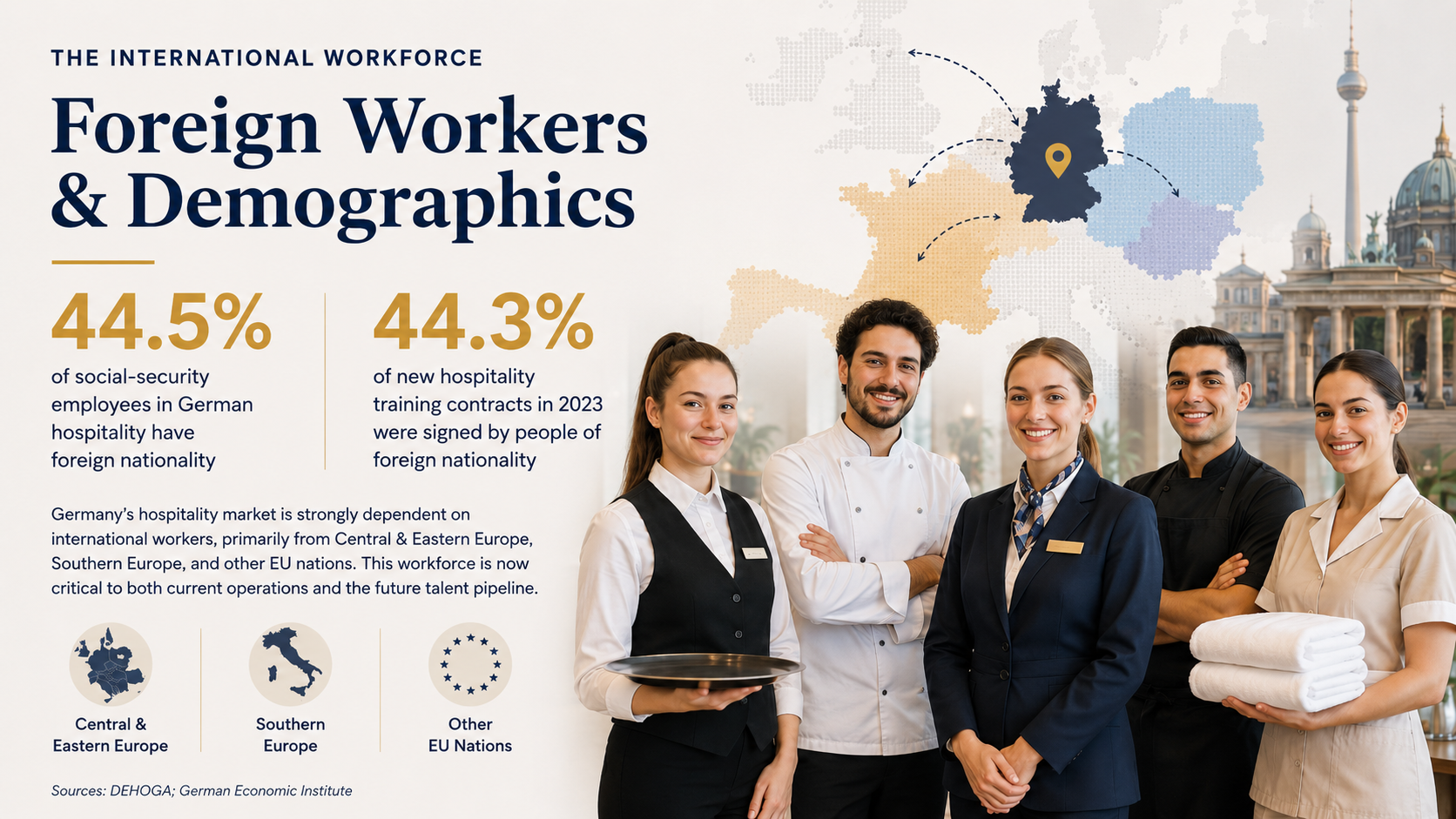
- • 44.5% of hospitality workers have foreign nationality—a critical dependency
- • International recruitment requires expertise in visa, legal, and administrative requirements
- • Language barriers impact onboarding, retention, and workplace integration
- • Housing availability is a critical constraint for international hires
Operational Recruitment Friction
- • Recruitment is fragmented across multiple channels (job boards, agencies, networks, direct applications)
- • Many small hospitality employers lack dedicated HR capacity
- • Limited employer support services for onboarding, retention, and integration
- • Regional differences in labour market conditions and workforce availability
Competitive & Market Pressures
- • Competition from other sectors (logistics, retail, healthcare, cleaning) for the same workforce
- • Wage and working condition pressures—hospitality often offers less attractive conditions
- • Limited career progression visibility in many hospitality roles
- • Seasonal and shift work create scheduling challenges
Workforce Composition & Impact
The German hospitality sector employs a diverse workforce across multiple employment types. See key data for detailed employment figures:
- → Full-time employees: Permanent hospitality professionals in management, operations, and leadership roles.
- → Part-time workers: Significant portion of the workforce; offers flexibility but affects retention.
- → Seasonal and temporary staff: Critical during peak seasons (tourism, holidays, events).
- → International workers: Often in operational roles; face language and integration challenges.
- → Apprentices & trainees: 51,582 people are currently in hospitality training occupations. They are important for the long-term workforce pipeline, but they do not offer an immediate recruitment solution.
Explore Market Insights & Solutions
Get detailed analysis and research materials about German hospitality recruitment trends and strategies.
Discuss Your NeedsHospitality Recruitment Market Forecast 2026–2030
The German hospitality recruitment market is expected to remain under sustained pressure through 2030. The following scenarios reflect possible market developments based on current trends and labour-market conditions.
⚠️ Important: The following scenarios are forecast ranges for internal strategic orientation. They are not official predictions and should be updated when new labour-market data becomes available.
Year-by-Year Market Outlook
2026
Market baseline: approximately 1.1 million social-security hospitality employees with 44.5% foreign-worker participation. Recruitment pressure remains visible with 17,667 registered vacancies. Employers continue to rely on multiple recruitment channels and international hiring partnerships.
2027
Recruitment pressure expected to remain stable or increase slightly. Employers likely increase investment in international recruitment partners, staffing agencies, and digital platforms. Structured onboarding processes become more critical as employers compete for talent. Foreign-worker share may rise to 45–46.5%.
2028
Foreign-worker participation expected to reach 46–48% of the workforce. Employers that develop strong onboarding, language support, housing guidance, and retention programs may gain competitive advantage. Wage pressures likely to increase. Market may fragment further with some employers investing heavily in recruitment while others struggle.
2029–2030
By 2030, the sector is expected to remain dependent on a mix of local recruitment, international hiring, apprenticeships, and flexible staffing. Competition with other service sectors likely intensifies. Hospitality employers may need stronger employer branding, faster recruitment processes, and improved retention systems to remain competitive. Foreign workers may comprise 48–50% of the workforce.
Forecast Scenario Table
| Year | Social Security Employment | Foreign-Worker Share | Estimated Foreign Workers | Registered Vacancy Pressure |
|---|---|---|---|---|
| 2026 | 1.09–1.12M | 44.5%–45.5% | 485,000–510,000 | 17,000–20,000 |
| 2027 | 1.10–1.12M | 45%–46.5% | 495,000–520,000 | 18,000–22,000 |
| 2028 | 1.11–1.13M | 46%–48% | 510,000–540,000 | 19,000–24,000 |
| 2029 | 1.12–1.14M | 47%–49% | 525,000–560,000 | 20,000–25,000 |
| 2030 | 1.13–1.15M | 48%–50% | 540,000–575,000 | 21,000–27,000 |
Scenario Notes: These forecast ranges assume continued labour-market pressure, sustained foreign-worker dependency, and ongoing recruitment challenges. The scenarios should be updated when official employment and vacancy data for 2026–2030 becomes available.
Strategic Insights & Hospitality Recruitment Opportunities
The Strategic Opportunity
The German hospitality sector presents a compelling market opportunity for recruitment platforms, staffing companies, hospitality technology providers, and workforce solutions providers. The market shows sustained, structural recruitment demand driven by factors that are unlikely to resolve quickly—staff shortages, high turnover, foreign-worker dependency, and operational complexity in onboarding and retention. Learn more about 2026–2030 projections.
Key Strategic Insights
The Recruitment Gap
Registered vacancies (17,667) do not capture the full recruitment need. See Key Data for detailed vacancy statistics. Industry experts and employer surveys suggest actual unfilled positions are significantly higher—many vacancies are filled through informal channels, agencies, and internal networks.
Implication: The true market opportunity is larger than official vacancy data suggests.
Foreign-Worker Dependency
At 44.5% of the workforce, foreign workers are not optional—they are essential to sector operations. Learn more in the Recruitment Pressure section. Yet recruitment, onboarding, and retention of international staff requires specialized expertise in visa requirements, language support, housing, and integration.
Implication: Solutions that address international recruitment and onboarding face strong market demand.
Fragmented & Inefficient Recruitment
No single dominant recruitment platform in German hospitality. Employers use multiple channels—some outdated. Many small hospitality businesses lack dedicated HR resources or structured recruitment processes.
Implication: Consolidation opportunity for platforms that can serve hospitality employers efficiently.
Retention & Support Services
High turnover is a persistent problem. Employers would benefit from structured onboarding, language training, housing support, and retention programs. These services are underprovided in the current market.
Implication: Employers may pay for solutions that improve retention and reduce replacement costs.
Opportunities by Stakeholder Type
For Recruitment Platforms & Job Boards
A large, persistent market of hospitality employers seeking candidates. Potential to build dominant platform for German hospitality by offering specialized features (shift management, language options, international candidate sourcing, employer support). Current market fragmentation means consolidation opportunity exists.
For Staffing & Recruitment Agencies
Growing demand for temporary, seasonal, and permanent staffing. Expertise in international recruitment (visas, compliance, document preparation) is a competitive advantage. Employers are willing to pay for reliable staffing solutions that reduce recruitment friction and time-to-hire.
For Hospitality Employers & Operators
Investment in modern recruitment and retention strategies will remain necessary through 2030. View the 2026–2030 Outlook to understand market trends. Employers that invest early in efficient recruitment channels, structured onboarding, and international staffing expertise may gain competitive advantage in attracting and retaining talent in a tight labour market.
For Technology & HR Solutions Providers
Solutions for shift management, multi-language onboarding, housing coordination, and retention analytics address real employer pain points. Market for such solutions is likely to grow as employers seek to professionalise their recruitment and HR processes.
For Investors & Market Participants
The German hospitality recruitment market offers structural demand that should remain visible through 2030. Market drivers (staff shortages, high turnover, foreign-worker dependency, wage pressures) are unlikely to resolve quickly. Consolidation and professionalisation of recruitment processes is likely, creating acquisition and investment opportunities.
Market Development Themes to Monitor
Conclusion & Strategic Market Insight
The German hospitality recruitment market for 2026–2030 stands at a decisive strategic moment. As Europe's largest hospitality market, Germany combines significant economic scale, high employment volumes, and persistent recruitment pressure. With approximately 2.2 million people employed in the sector, €118 billion in annual turnover, more than 206,000 hospitality companies, and 17,667 registered vacancies in January 2026, the market represents both a major operational challenge for employers and a strong opportunity for recruitment platforms, staffing agencies, and workforce solution providers.
Current market dynamics reveal a sector that is structurally dependent on international talent. With 44.5% of social-security hospitality employees holding foreign nationality, international workers are no longer a secondary part of the labour market; they are essential to the daily functioning of hotels, restaurants, catering companies, event operators, and tourism-related businesses. This dependence creates a clear need for recruitment solutions that go beyond simple candidate matching and include visa guidance, compliance support, language assistance, housing coordination, onboarding, and retention strategies.
The official vacancy figure does not fully reflect the real recruitment pressure in the sector. Many hospitality vacancies are filled through informal networks, agencies, direct applications, temporary staffing providers, or remain unregistered. This means the true market opportunity is likely larger than official vacancy data suggests. Employers continue to face shortages in operational roles such as housekeeping, kitchen staff, service, reception, catering, and seasonal hospitality positions.
At the same time, the German hospitality recruitment market remains highly fragmented. Employers use multiple recruitment channels, often without a structured or centralised hiring process. Many small and medium-sized hospitality businesses lack dedicated HR capacity and struggle to manage recruitment, onboarding, and retention professionally. This fragmentation creates inefficiency, higher replacement costs, slower hiring, and weaker candidate experiences.
Strategically, the market is moving toward professionalisation. Employers that invest in stronger recruitment processes, international hiring expertise, employer branding, multilingual onboarding, and retention support will be better positioned to compete for talent through 2030. For recruitment platforms, staffing companies, HR technology providers, and investors, this creates a clear opportunity to serve a large market with recurring demand and unresolved structural pain points.
The key insight is clear: Germany's hospitality recruitment challenge is not temporary. It is structural. Labour shortages, demographic pressure, competition from other service sectors, high turnover, foreign-worker dependency, and fragmented recruitment channels will continue to shape the market over the coming years. Stakeholders that can reduce hiring friction, support international workforce integration, and help employers retain staff will be well positioned to capture value in the German hospitality recruitment market from 2026–2030 and beyond.
Want to discuss this market analysis or explore opportunities?
Report Authors & Hospitality Recruitment Expertise
This market analysis is authored by the leadership and country team behind CatchJobs, combining deep industry experience, technology strategy, and local market knowledge. Full author credentials and additional resources are available in our Press & Evidence Library.
Burak Birand
Co-founder & CEO – CatchJobs
Recruitment Technology & Business Growth Strategist
Co-founder and CEO of CatchJobs, leading the company's overall vision, platform development, commercial strategy, and international growth. Burak brings strong strategic insight into the future of hospitality recruitment through a background in operations, technology, business development, and service-sector entrepreneurship.
His leadership combines technology, market understanding, operational thinking, and a strong focus on practical execution. Burak understands that hospitality employers need speed, reliability, personality, and flexibility in their hiring process. He shapes CatchJobs as a scalable recruitment platform that helps hotels, restaurants, cafés, and service-driven employers connect with talent in a smarter, more direct way.
Chris J. Maxwell
Co-founder – CatchJobs
Hospitality Entrepreneur, Chef & Candidate Experience Specialist
Co-founder of CatchJobs with deep first-hand experience from the hospitality industry. As a chef, entrepreneur, and creative professional, Chris brings direct understanding of what hospitality businesses need from their teams and what candidates need to present themselves effectively.
Chris brings the human side of hospitality recruitment into focus. His hands-on experience with fast-paced environments, service pressure, team dynamics, personality, and reliability helps ensure CatchJobs reflects the real needs of both employers and candidates. His international background supports CatchJobs' broader vision: making recruitment more personal, visual, accessible, and relevant for a modern hospitality workforce.
George Kanis
Country Lead Netherlands – CatchJobs
Entrepreneur & Hospitality Market Strategist
Country Lead for CatchJobs in the Netherlands with 25+ years of experience in entrepreneurship, hospitality, education, and business development. George combines local Dutch market knowledge with deep understanding of the hospitality sector's current challenges: staff shortages, fragmented hiring processes, high turnover, and the growing need for faster, more personal recruitment solutions.
As an author and concept developer, George brings strategic communication perspective to CatchJobs' market positioning, helping translate the recruitment platform concept into a strong approach for the Netherlands, connecting hospitality employers with smarter and more human talent solutions.
Market Research Sources & Data Notes
Data Sources
- • DEHOGA Bundesverband – German hospitality industry association; sector employment, turnover, and structure data.
- • DEHOGA Zahlenspiegel – Quarterly industry statistics and market reports.
- • Federal Employment Agency (Bundesagentur für Arbeit) – Official vacancy, employment, and labour-market data.
- • Destatis – German statistical office; accommodation, food service, turnover, and employment data.
- • Eurostat – EU statistical office; comparative labour-market and sector employment data.
Data Limitations & Notes
- • Social-security employment does not include all hospitality work (e.g., marginal employment, informal work).
- • Registered vacancies represent only positions reported to the Federal Employment Agency; many vacancies are filled through other channels.
- • Future figures (2027–2030) are forecast ranges and scenario-based estimates, not official predictions.
- • Foreign-worker share reflects workers with foreign nationality among social-security employees only.
- • Data should be verified and updated before use in formal decision-making or external publication.
Disclaimer
This market intelligence report is intended for private informational use and strategic orientation. The data, figures, and observations presented are based on available sources and should be reviewed, verified, and updated before being used for formal decision-making, investment purposes, or external publication.
The report does not claim to provide official future forecasts. Any figures beyond the latest available data should be treated as scenario-based estimates for internal discussion only. All data should be cross-referenced with official sources before external use.
This report was created for research and strategic discussion purposes. Accuracy and currency of data are not guaranteed.